Les secrets de l'Alhambra
- From tuesday, november 24 to sunday, may 16, 2027
- 11:00 AM-8:00 PM
- Institut du Monde Arabe 1 Rue des Fossés Saint-Bernard, 75005 Paris, France
Info
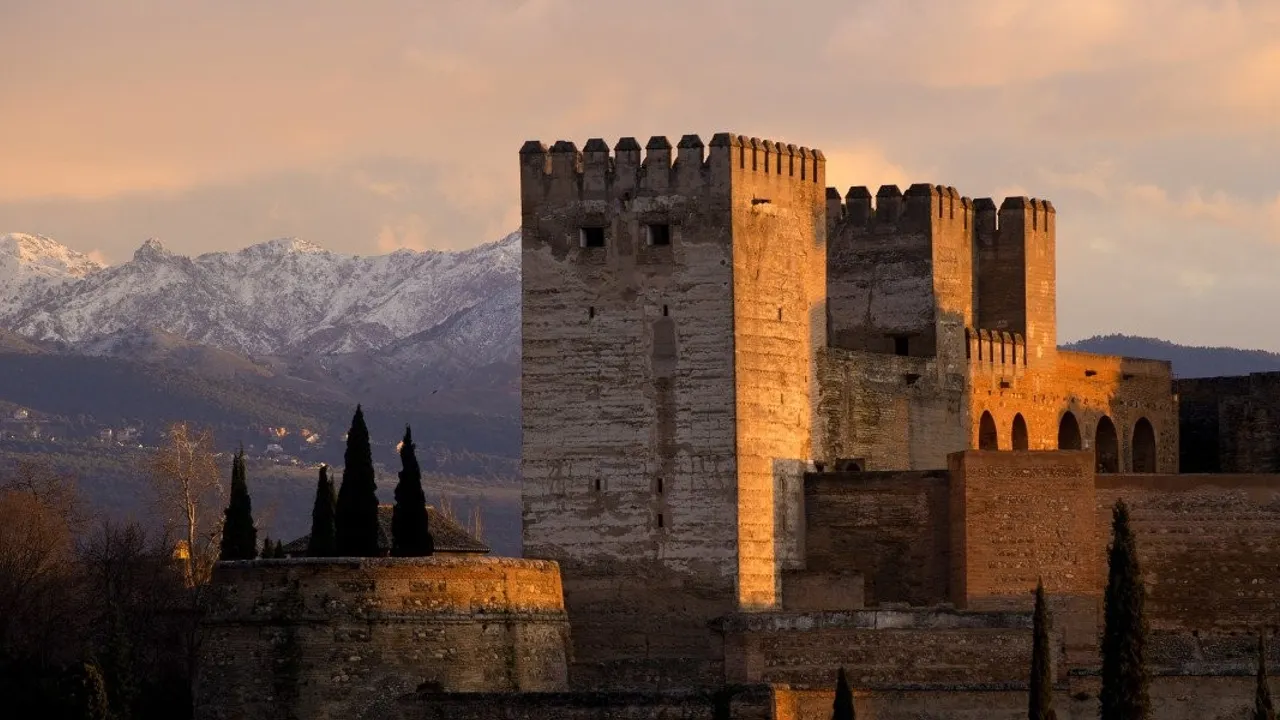
Jewel of Islamic art, a unique Muslim palatial complex preserved in the West, the Alhambra is one of the most visited monuments in the world. It is the Alhambra as built by the Nasrid sultans – quite different from the fortress as it stands today – that the exhibition highlights, unveiling and decoding some of its secrets at the height of its splendor, during the reign of Sultan Muhammad V in the 14th century, along an engaging immersive journey punctuated by wonderful works of art.
Evoking the genius of the Lion Fountain, the poetry of water, the geometric complexities of the decoration, the refinement of epigraphy that gives voice to the palace, the splendor of sultanate festivities, the sensuality of the gardens, and the cultural exchanges despite the constant military tensions: this exhibition tells the Nasrid Alhambra, illuminates its splendor, and reveals some of its mysteries.
A guided stroll through the forthcoming exhibition
The beauty of the Alhambra might lead one to forget that it is first and foremost a fortress, ringed by walls and towers and the seat of a garrison, and that the Nasrid emirate is in reality a state hanging by a thread, threatened and steadily gnawed by neighboring states. Alongside a selection of weapons and pieces of armor and harness, the immersion will allow visitors to discover a hidden and little-known masterpiece of Arab painting, showing the return of a victorious military expedition.
The Lion Fountain, which gave its current name to the palace that houses it, the most iconic piece of the Alhambra and a masterpiece of Nasrid art, was modified over the centuries following the Christian conquest. What did it look like during the reign of Muhammad V, who had it installed? Around a copy of the fountain, visitors will discover various scientific hypotheses about its meaning, form, and operation. A major piece of the exhibition, it will also provide an opportunity to address the importance of water for the entire palace complex, both aesthetically and for its essential role in the life of the site.
To exalt the perfection of divine creation without imitation, Muslim artists, and particularly the Nasrids, used abstraction enabled by mathematical rigor. Thus the entire edifice, both architecturally and ornamentally, rests on the infinite repetition of geometric motifs. The decorative patterns are the result of compositions formed from motifs that move and rotate according to all forms of symmetry, thereby giving rise in turn to new, highly varied geometric forms. A section of the exhibition is devoted to these tracings and their method, to the discovery of a major artistic principle, typically Muslim, developed on different supports, whether the palace's ceramic walls or art objects that decorated it: silks, manuscripts, woodwork, inlays, etc.
An essential element of the Alhambra's aesthetic, colors are magnified by light, which creates chromatic effects and movement on various decorative motifs. The display of this intense polychromy, which is only partially detectable today, will be made possible by immersive techniques, highlighting the lighting effects on the Lindaraja ceiling, as well as the details and the finesse of the muqarnas or ceilings.
The walls of the Alhambra are covered with inscriptions. Far from being confined to a mere decorative function, these are literally the voice of the palace. Visitors are invited to discover the different types of calligraphy and to read certain inscriptions by deciphering them within complex ornamental motifs—mottos, the word baraka, poems, Quranic verses—while absorbing their musicality through an audio recording of their reading. Here again, a selective array of artworks will show that this decorative principle based on calligraphy extends far beyond the palace walls.
Despite the Nasrid emirate's fluctuating relations with neighboring states, artistic exchanges are particularly fruitful, as evidenced by works coming from both Christian and Islamic worlds. The exhibition will also decode the paintings in the Hall of the Kings, with its surprising iconography in a Muslim palace.
Historical sources and the poetry diwans recount the sumptuous festivities organized within the palace on the occasion of Mawlid (the Prophet's birthday), royal weddings, or the circumcisions of the sultan’s sons. To recreate the ambiance and splendor, set to music, the exhibition will present the splendor of the works and the reconstruction of the automaton shown at Mawlid of 1362.
It ends with a sensuous evocation of the garden. Is not the Alhambra a metaphor of the garden? Beyond references to the Garden of Paradise or earthly gardens etched on its walls, the fortress contains real gardens, both for pleasure and for production. To discover, an installation created for the occasion, based on scientific knowledge relating to the Alhambra's gardens, engages our senses, notably hearing and smell...
Participants
Venue
Institut du Monde Arabe
1 Rue des Fossés Saint-Bernard, 75005 Paris, France