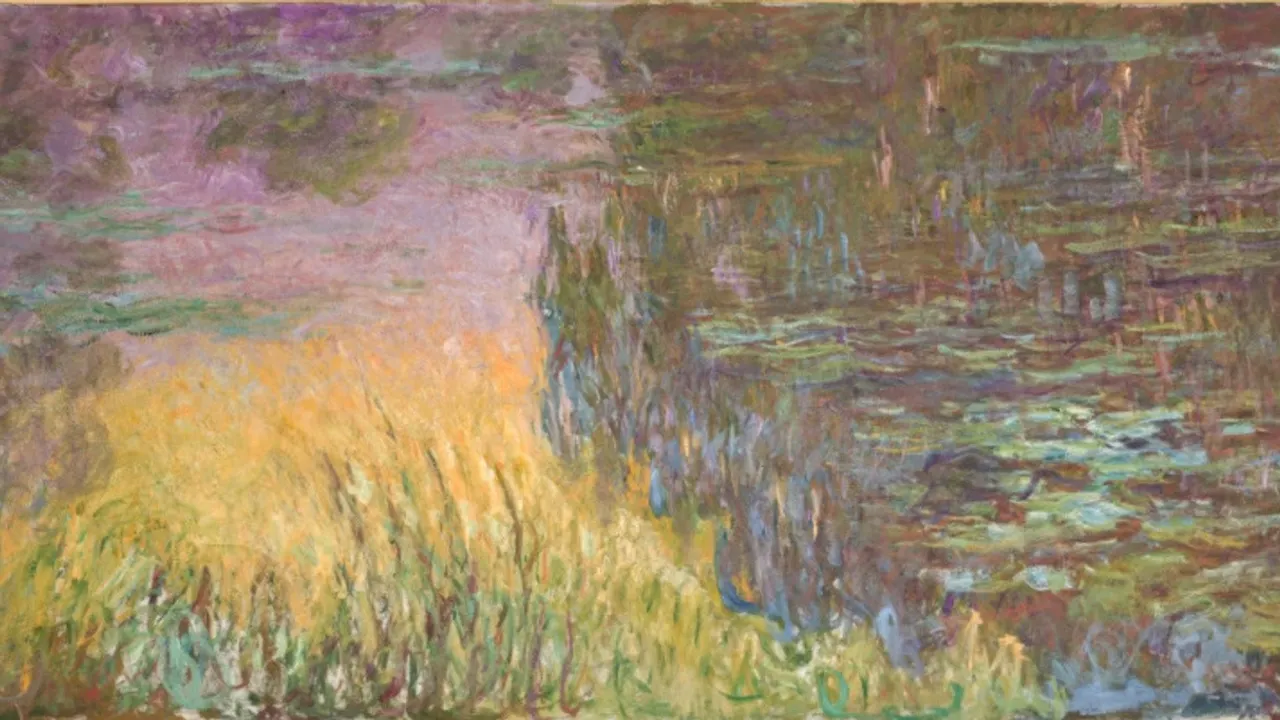
© Claude Monet, Soleil couchant, entre 1914 et 1926, Musée de l'Orangerie, © Musée de l'Orangerie, dist. RMN-Grand Palais / Patrice Schmidt
Monet, peindre le temps
- De quarta-feira, setembro 30 a segunda-feira, janeiro 25, 2027
- 11:00-19:00
- Le Musée de l'Orangerie Jardin des Tuileries, 75001 Paris, França
Info
The year 2026 will mark the centenary of the death of the painter Claude Monet (1840–1926). To commemorate this anniversary, the Musée de l’Orangerie is organizing an exhibition focused on the relationship between Monet’s work and time. From the 1870s he was regarded as the Impressionist artist, although he took part in only five exhibitions of the group. His work soon came to be synonymous with the “new painting,” so completely does it encapsulate its characteristics (most often painted en plein air, with quick brushstrokes and clear harmonies conveying the impression of a moment), before leading to one of its extensions. In the 1890s, with series such as The Cathedrals, The Haystacks, The Poplars, the painter reveals an approach close to a dissection of time, culminating in the final testament of the Water Lilies, which resolves the problem of fragmentation within the series by dissolving into a continuum. A selection of nearly forty paintings by Monet, drawn primarily from the collections of the Musée d’Orsay and the Musée Marmottan Monet, but also from loans by public and private collections in France and abroad, will highlight these different moments, with particular emphasis on the cycle of the Water Lilies. From this perspective and with a distanced viewpoint that invokes various fields of research, the exhibition will propose a reexamination of a body of work whose significance remains considerable a hundred years later.
The exhibition is hosted at the Musée de l’Orangerie, which houses the major Water Lilies decorations. This ensemble bears witness to the work of Monet’s final years, conceived as an environment and crowning the Water Lilies cycle. The itinerary invites reflection on the sense of an acceleration of time and on modernity during the artist’s Impressionist period, on the capture of instantaneity through series, and finally on the Water Lilies cycle, in search of a transcription of duration. Monet developed a painting that responded to the challenges and upheavals of his era with regard to the notion of time—from both a lived and felt perspective, and also as something tangible through the concrete signs of transformation in urban space and the landscape. The nineteenth century saw the multiplication of clocks in public spaces and the synchronization of measured time; it was also the century of the transportation revolution and the expansion of railways. Monet’s Impressionist moment thus appears, in echo of this revolution in the apprehension of time in the nineteenth century, as a painting that increasingly sought to embody instantaneity.
After the years of the Impressionist exhibitions, the artist showed a tendency to explore the effects produced at different times of day on a single subject. It was in Normandy that he ultimately developed his series around the Haystacks (1888–1891), the Poplars on the banks of the Epte (1891–1892), the Mornings on the Seine (1896–1897) as well as the Rouen Cathedral (1892–1898). Through these series, the painter pushed the logic of representing the moment to the point of fragmenting time in order better to grasp its essence. In 1895, the Rouen Cathedrals exhibited at Durand-Ruel were, for Clemenceau, “a revolution without a shot fired” (Clemenceau, “Révolution de Cathédrales,” 1895, La Justice). With these pictorial investigations, Monet seemed to partake in his era’s fascination with meticulous and almost scientific observation of the surrounding world.
In the 1890s Monet began the final cycle that would occupy him until his death in 1926: the Water Lilies. This cycle comprises more than two hundred and fifty canvases devoted to a single subject and was crowned by the creation of the two rooms specifically designed to receive his large panels, which were offered to France in the aftermath of the 1918 armistice—the artist’s final work, inaugurated a year after his death, in 1927. Everything contributes to offering the viewer an immersion in the work that approaches duration in the Bergsonian sense of the term.
Monet along the Water
Virtual Reality Experience
This immersive project accompanies the exhibition “Monet, Painting Time.” Titled “Monet — Along the Water,” the virtual reality experience will offer a journey into the heart of the master Impressionist’s oeuvre. Lasting twenty minutes, this sequence is based on the virtual reality experience “The Obsession of the Water Lilies,” produced in 2018 by Lucid Realities and presented at the Musée de l’Orangerie in 2018 and 2024.
From Argenteuil to Giverny, from the Seine to the water-lily basin, the experience takes us to discover the work of Claude Monet and his obsession with capturing the course of time in the depiction of a landscape: the effects of light that change with the hours and the seasons—his series (the Poplars, the Mornings, the Water Lily Ponds, the Water Landscapes, the Japanese Bridges, the Large Decorations…), the history of his house in Giverny and his pond, but also his struggle with failing eyesight and his movement toward an almost abstract painting.
This virtual reality experience is offered on a standalone headset and is available in French and English.
Local
Le Musée de l'Orangerie
Jardin des Tuileries, 75001 Paris, França