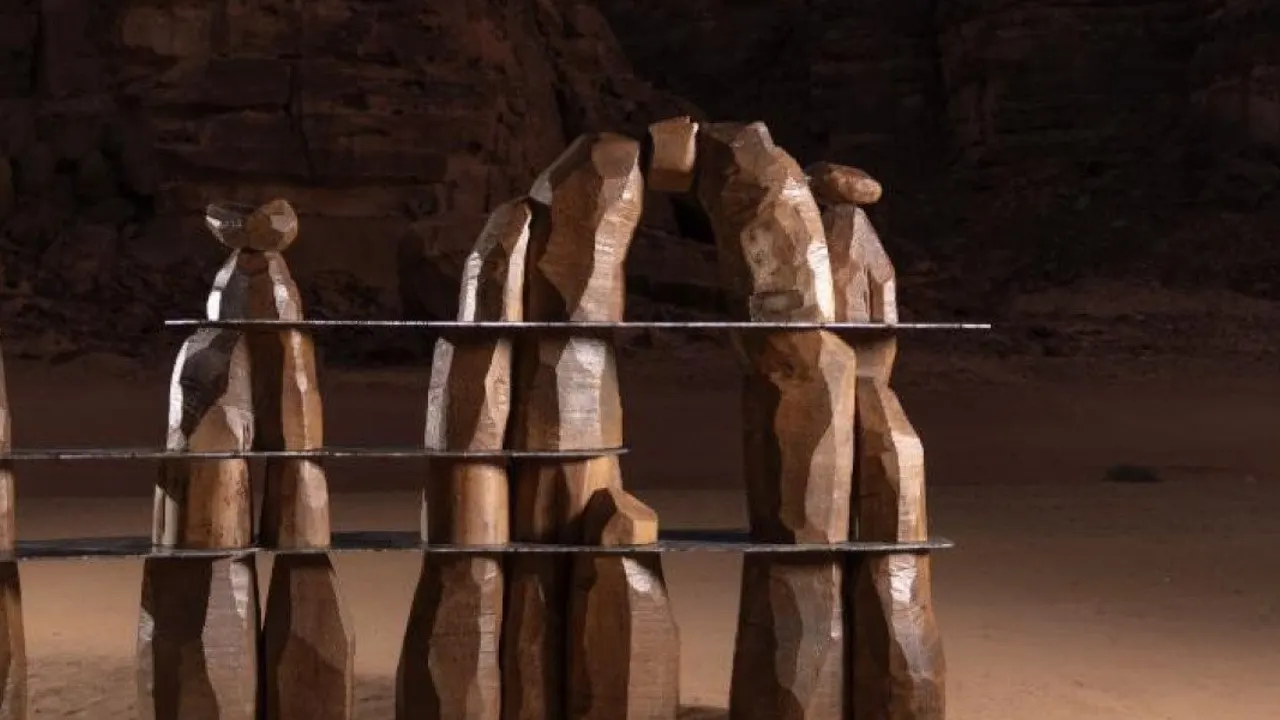
Exposition AlUla, design d’un territoire vivant
- Vom donnerstag, september 10 bis sonntag, september 20
- 12:00-20:00
- Institut du Monde Arabe 1 Rue des Fossés Saint-Bernard, 75005 Paris, Frankreich
Info
What does it mean to build in a desert without altering its natural character? How can one create comfort and novelty without threatening fragile ecosystems? How to welcome visitors while respecting the rhythms, know-how, and local resources?
To seek answers to these questions, the Royal Commission for AlUla and AFALULA established an art and design residency five years ago. Since 2021, five artists and designers are invited each year to participate in a three-month research and experimentation residency in AlUla, followed by a production phase during which they develop projects nourished by local know-how, materials, landscapes and the place’s history.
AlUla is undergoing rapid transformation, and the way the oasis evolves is essential. Design is one of the means by which this transformation takes shape, whether in public spaces, product design, or craftsmanship. In this context, residencies bridge research and production.
This focus on AlUla, on the occasion of the Arab Design Prize, traces the entire creative process—from the initial sketches and models to prototypes, and, in some cases, to the commercial production of the object.
Villa Hegra
Villa Hegra chose Paul Emilieu Marchesseau as the first resident of its temporary building, entrusting him with the layout of the five studios intended for future invited artists. Building on his reflections on modularity, practicality, and the use of locally collected materials, he designed three objects essential to the daily life of creators: a gallery rail, a table on trestles, and a workshop lamp. Paired with the tools provided by Villa Hegra, these items enable invited artists to shape their workspace according to their needs.
Many contributors participated in the design of these three elements. The modular gallery rail is fitted with a zippered cover, designed with the French textile designer Marianna Ladreyt. The embroidered motifs shared by the three objects, conceived by Shaddah Design Studio in Riyadh, were partly realized by the embroiderers at the Madrasat Adeera School in AlUla. The structural elements were produced by the Saudi agency Alphaplus, which developed the project according to the designer’s drawings.
Villa Hegra is an institution dedicated to cultural dialogue between France and Saudi Arabia, located in AlUla. Created under an intergovernmental agreement signed in 2021, it develops residencies and public programming in the arts, cinema, design, research and the creative industries to strengthen exchanges between the two countries.
Paul Emilieu Marchesseau
Trestles
2026
Local palm wood, nails
Commissioned by Villa Hegra and manufactured by Yram, Saudi Arabia
Courtesy of the artist
Paul Emilieu Marchesseau
Mobile storage
2026
Polished stainless steel, embroidered cotton cover, stainless steel tube
Embroidery designed with Shaddah Design Studio
Commissioned and produced by Villa Hegra
Courtesy of the artist
Paul Emilieu Marchesseau
Mobile lamp
2026
Polished stainless steel, textile, PLA 3D printing
Commissioned by Villa Hegra and manufactured by Yram, Saudi Arabia
Courtesy of the artist
Born in 1988 in Châteauroux, France. He lives and works in Paris, France.
Paul Emilieu Marchesseau, founder of Emilieu Studio in Paris, develops a practice of design, interior architecture and scenography rooted in eco-design and functionality. As part of his one-year residency at Villa Hegra, he developed a set of modular furniture intended for future residents. Fully produced in Saudi Arabia, the project relies on a network of artisan workshops. Working with Shaddah Studio, a graphic design and design collective, enriches the project through the integration of graphic elements and embroideries tied to Saudi heritage and contemporary culture. Keen to incorporate daily life and activities into his practice, he developed an autonomous sound system as well as solar panels mounted on a rugged all-terrain wheeled chassis to sound and power nomadic workshops between the oasis and the desert.
As a venue devoted to the arts, design and local craftsmanship open to the public in AlUla, Madrasat Adeera plays a role in preserving and reinventing the region’s artisanal traditions. The school preserves local know-how while encouraging innovation through experimentation and collaboration. From palm-leaf weaving to ceramics, wood and stone carving, textile work, jewelry making, candle and soap making, geometric design, painting and the use of natural materials, crafts are seen there as a living and evolving practice.
The works presented are part of a partnership between Arts AlUla, Madrasat Adeera, the King’s Foundation School of Traditional Arts, Turquoise Mountain and Creative Dialogue. They belong to Madrasat Adeera Editions and Madrasat Adeera Statement Pieces, two collections that transform local narratives and know-how into contemporary objects through designers’ intervention.
Combining traditional techniques with innovative and durable materials, notably palm, wood, clay, textile, embroidery, leather, natural cellulose and bioplastics, these collections bring together functional objects that embody the region’s identity while showing how heritage can inspire contemporary design.
Madrasat Adeera Editions No. 1
AlWaha
2023
Screen
Designed by Cristián Mohaded
Produced by the artisans of khous and Miguel Álvarez Hausmann
Commissioned and produced by the Royal Commission for AlUla in collaboration with A Creative Dialogue
Courtesy of the Royal Commission for AlUla
AlWaha highlights the technical, formal and physical qualities of khous, the art of palm leaf weaving, one of the traditional crafts common to Saudi heritage. The concept of the AlWaha screen embodies the essence of khous in design and art. Inspired by the undulations of the desert’s sand dunes and the tranquil greenery of oases, the screen’s intricate weaving blends ancestral local techniques with innovations.
Created by Madrasat Adeera
From Dadan
2025-2026
Decorative rug
Palm bark, canvas, leather thread, raw jute rope, PVC glue, industrial sewing machine
Commissioned and produced by the Royal Commission for AlUla in collaboration with Turquoise Mountain
Courtesy of the Royal Commission for AlUla
At the crossroads of ancient history and contemporary design, From Dadan explores new possibilities in artisanal craft. Handmade from AlUla palm bark and sewn jute rope, this decorative rug reflects the contours and topography of the region’s landscapes. Each line tells a place-and-time-linked story, creating a tactile, grounded piece that connects the domestic space to AlUla’s heritage.
Created by Madrasat Adeera
Between Endurance & Bloom
2025-2026
Brooch
Sterling silver, gold leafing solution, amethyst, peridot
Commissioned and produced by the Royal Commission for AlUla in collaboration with Turquoise Mountain
Courtesy of the Royal Commission for AlUla
Resulting from an artistic collaboration with designer and craftswoman Hanan AlBalawi, the Between Endurance & Bloom collection embodies the harmony between resilience and renewal in a sterling silver brooch plated with gold, combining the Nubian ibex’s strength with the delicacy of watercress. Adorned with engraved textures, contrasting finishes, touches of green peridot and a violet amethyst, this fluid-line brooch merges imposing horns with delicate leaves, paying homage to desert determination and grace.
Madrasat Adeera Creations
Layers That Remember
2025-2026
Set of candlesticks, plant holder and keychain
Faience, glossy transparent glaze, beeswax, C3, wicks, wick stickers, wooden and silicone assemblies
Commissioned and produced by the Royal Commission for AlUla in collaboration with Turquoise Mountain
Courtesy of the Royal Commission for AlUla
Inspired by AlUla’s stratified sandstone landscapes, the Layers That Remember collection translates geology into a series of sculptural ceramic containers. Made by hand from a blend of natural clays, these pieces evoke erosion and the region’s millennia-carved sedimentary layers. Designed to hold candles, plants or personal objects, this collection brings the desert’s presence into moments of reflection.
Madrasat Adeera Limited Edition Jadeela/Braid
2025
Hand-carved wooden tile
Commissioned and produced by the Royal Commission for AlUla in collaboration with the King’s Foundation
Courtesy of the Royal Commission for AlUla
Madrasat Adeera Limited Edition Pure Water
2025
Wooden box with palm leaf lid
Commissioned and produced by the Royal Commission for AlUla in collaboration with the King’s Foundation
Courtesy of the Royal Commission for AlUla
This collection of artisanal objects blends meticulous wood carving with traditional palm leaf weaving. The wooden tile features a geometric border and a floral motif inspired by AlUla’s landscapes. The wooden box is topped with a lid made from braided palm leaves. Together, these pieces showcase natural materials and traditional know-how through simple, functional forms.
Madrasat Adeera Limited Edition AlUla Summer
2025
Paint with natural pigments on watercolor paper, wooden frame
Commissioned and produced by the Royal Commission for AlUla in collaboration with the King’s Foundation
Courtesy of the Royal Commission for AlUla
Inspired by the region’s natural hues and landscapes, this work pays homage to AlUla’s summer colors. The brushwork highlights the harmony between traditional painting techniques and nature-inspired geometry.
Madrasat Adeera Limited Edition Golden Hours in the Oasis
2025
Egg tempera on wooden panel, natural pigments
Commissioned and produced by the Royal Commission for AlUla in collaboration with the King’s Foundation
Courtesy of the Royal Commission for AlUla
This historic technique highlights a color palette and a subtle texture, revealing artisanal know-how on a wooden support.
Madrasat Adeera Limited Edition Nabati Study
2025
Handmade paper painting, unframed, A3
Commissioned and produced by the Royal Commission for AlUla in collaboration with the King’s Foundation
Courtesy of the Royal Commission for AlUla
This work is a motif study employing floral shapes in a symmetrical composition with a rotational movement. It pays homage to AlUla’s flora and the ordering of natural elements.
Madrasat Adeera Limited Edition Geomeric Pathways
2025
Drawings, unframed, A3, mixed media on paper
Commissioned and produced by the Royal Commission for AlUla in collaboration with the King’s Foundation
Courtesy of the Royal Commission for AlUla
Geometry and natural order are present in AlUla, and these sketches illustrate the craftsperson’s practice, exploration, technical precision and creative process.
Madrasat Adeera Limited Edition Khamsa
Framed work
2025
Analytic geometry drawing, framed, mixed media on paper
Commissioned and produced by the Royal Commission for AlUla in collaboration with the King’s Foundation
Courtesy of the Royal Commission for AlUla
This hand-drawn geometry is inspired by a flower found in AlUla’s oasis. The flower’s analysis is the result of fieldwork conducted within a Madrasat Adeera artist residency program, and highlights the pentagonal geometry of the petal structure.
Madrasat Adeera Limited Edition Becoming (Wujud)
2025
Embroidered linen pouch
Linen, naturally dyed silk thread, magnetic clasp
Commissioned and produced by the Royal Commission for AlUla in collaboration with the King’s Foundation
Courtesy of the Royal Commission for AlUla
This hand-embroidered linen pouch sewn with silk thread dyed with natural dyes is inspired by the colors of the AlUla region. The textures and natural materials celebrate traditional textile arts through a simple and contemporary form.
Madrasat Adeera Limited Edition Flowers of Hegra 5
2025
Limestone square carved with a Hegra flower
Commissioned and produced by the Royal Commission for AlUla in collaboration with the King’s Foundation
Courtesy of the Royal Commission for AlUla
Hand-carved from limestone, the Flowers of Hegra are tied to AlUla’s archaeological heritage and to the stone-carving techniques already practiced by the Nabataeans. This work results from a study of the historic floral sculptures visible at the Hegra site.
AlUla Design Award / AlUla Designathon
The AlUla Design Award and the AlUla Designathon share a common vision of design as a driver for renewing forms. Rooted in AlUla’s artisanal heritage, they show how traditional know-how can inspire contemporary creation with tangible impact.
Since 2022, the AlUla Design Award invites designers from around the world to reinterpret AlUla’s material culture through fashion design and product design. By combining ancestral techniques with new materials and technologies, it supports the creation of objects ready for commercialization.
Since last year, the AlUla Designathon has been designed as an immersive program, grounded in experimentation and practical application, offering young designers from the region the opportunity to work, learn and create in AlUla. Throughout the program, designers from fashion design, product design and graphic design come together, guided by mentors to conduct field research, prototyping and collective critique. Participants explore creation as a shared process based on experimentation, dialogue, and a constant attention to place.
Shaddah Studio
Twa Chair
2024
Braided jute and black steel, cotton rope and black snaps, leather handles
Commissioned and produced by the Royal Commission for AlUla as part of the AlUla Design Award
Courtesy of the studio
Collective consisting of Watfa Hamidaddin and Deem Alhagbani, founded in 2015 in Riyadh, Saudi Arabia.
With a design approach anchored in understanding the local context and open to the world, the studio seeks to contribute to the development of multidisciplinary creation in Saudi Arabia. The chair presented here, titled Tawa, which means “folded” in Arabic, embodies the idea of transition and mobility, reflecting contrasting feelings of escape and belonging that one can experience in AlUla.
Portable and transformable, this chair is designed to adapt to different uses: it can be unfolded to become a rug. Made by artisans in AlUla from local materials, Tawa combines natural elements with traditional artisanal know-how.
Its form draws on the region’s landscapes, from the mountains’ silhouette to the extent of the palm groves. It pairs earthy tones evoking desert and agricultural landscapes with deeper hues, navy, deep blue and violet, echoing the night sky and its astronomical dimension.
Abdulrahman Al Muftah
Bird Whistle
2026
Hand-formed earthenware
Commissioned and produced by the Royal Commission for AlUla as part of the AlUla Design Award
Courtesy of the Royal Commission for AlUla
At the crossroads of product design, publishing and craft, Abdulrahman Al Muftah’s practice is guided by material experimentation and a focus on sustainability in his creative process. He places importance on local resources as well as the sensory experience his objects evoke. For him, contemporary design is linked to the preservation of cultural heritage.
Bird Whistle is a collection of handmade terracotta whistles designed to reproduce the songs of endemic bird species in AlUla. Each piece is unique, its form meticulously shaped to define the sound it produces. For these sculptures that are also instruments, the shaping is also an act of tuning.
Clay becomes a tool for listening and observation. This series invites a new look at AlUla’s biodiversity, turning environmental awareness into objects that can be handled.
Harry Dobbs
Al Hajar
2022
3D printing
Commissioned and produced by the Royal Commission for AlUla as part of the AlUla Design Award
Courtesy of the Royal Commission for AlUla
Harry Dobbs develops contextually anchored creations, based on cultural research and an understanding of the behaviors and identity of a place. Dialogue with communities and users is central to his creative process. His research aims to rethink how the characteristics of a region can be transposed into objects and to imagine new material cultures.
The Al Hajar ensemble was created from AlUla sandstone ground into powder, a rock abundant in the region, then incorporated into clay. This composite material was then used for 3D printing to reconstitute the sandstone mountains in a new form.
The carafe and cups echo the sedimentary strata visible in the landscape, while evoking the preciousness of water in the Hijaz desert.
Matthieu Gautier
Monumental Miniature
2026
Metal
Commissioned and produced by the Royal Commission for AlUla as part of the AlUla Design Award
Courtesy of the Royal Commission for AlUla
Matthieu Gautier is a fashion and jewelry designer. Under the name Mutagene, his practice explores the boundary between adornment and sculpture, combining digital precision with hand-finishing to create experimental and wearable forms.
Monumental Miniature reinterprets the carved sandstone tombs of Hegra as a hybrid form of a ring and an ear cuff. Evoking a cracked stone, the piece reveals an interior stepped motif inspired by Nabataean façades.
Cast in metal, it translates monumental architecture into an intimate object, balancing rough and smooth textures and reflecting the dialogue between human intervention, landscape and body.
Jaco.mnes
Unfolded Hills
2025
Paint on fabric
Commissioned and produced by the Royal Commission for AlUla as part of the AlUla Design Award
Courtesy of the Royal Commission for AlUla
Collective consisting of Alexis Jacob and Pauline Omnes.
Jaco.mnes studio works at the crossroads of art, design, publishing and scenography. Their approach explores repetition, gesture and the narrative potential of functional objects.
Unfolded Hills is the prototype of a modular textile object inspired by nomadic life and desert landscapes, where mountains unfold in successive layers. Designed as a cushion that opens like a book, it consists of wool pages sewn together and bound by a braided cord.
Dyed from native AlUla plants, the piece can be rearranged, unfolded or repurposed from its initial use, embodying notions of mobility and adaptability. It also evokes textile traditions, reinterpreted for contemporary use.
Mohammad Jaafar
Stool
2025
Wood
Commissioned and produced by the Royal Commission for AlUla as part of the Designathon
Courtesy of the Royal Commission for AlUla
Traditionally designed for everyday spaces, these stools reimagine a universal seating type through a place-specific approach. They present themselves as design objects defined by their use, their material and their surroundings. Made in Saudi Arabia from palm wood sourced locally, this piece rests on a material anchored in the region’s ecological and cultural context.
This stool was made from a template designed by Mohammad Jaafar and is the result of a collaboration between the designer and local artisans.
Arwa Atwa
Lamp
2025
3D printing on sand
Commissioned and produced by the Royal Commission for AlUla as part of the Designathon
Courtesy of the Royal Commission for AlUla
3D-printed from sand and developed as part of the AlUla Designathon, The Eternity Lamp explores light as a material condition shaped by the landscape.
Inspired by the layered silhouettes of the AlUla mountains, the lamp translates geological formations into a clean, volumetric form. The technique allows shaping the sand with precision while preserving its granular and mineral character.
Built layer by layer, the piece bears witness to accumulation and the passage of time, echoing the geological processes that shaped AlUla.
AlUla Design Residency
Participants
Ort
Institut du Monde Arabe
1 Rue des Fossés Saint-Bernard, 75005 Paris, Frankreich