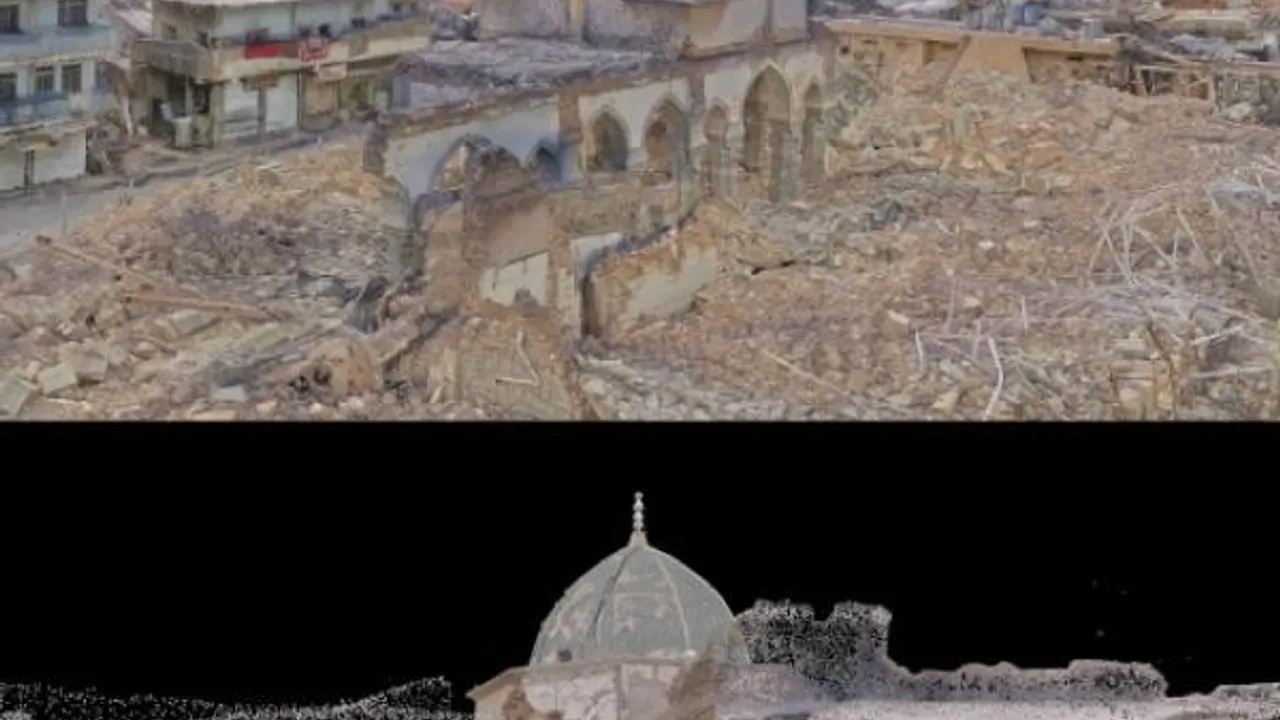
© Numérisation de la vieille ville de Mossoul, Irak, 2018 © Iconem, UNESCO
Patrimoines en résistance
- Vom mittwoch, mai 20 bis sonntag, januar 3, 2027
- 13:00-20:00
- Cité de l'architecture et du patrimoine - Palais de Chaillot 1 place du Trocadéro, 75016 Paris, Frankreich
Info
Heritage in Resistance – From Timbuktu to Odessa
The exhibition brings together an exceptional collection of graphic documents, contemporary artworks, and digital replicas of lost sites. In the manner of a major reportage, the assemblage weaves a documentary, visual, and emotionally resonant narrative, where the views of actors and witnesses, architects and artists intersect.
From Timbuktu to Odessa, from Bamiyan to Gaza, armed conflicts make heritage a prime target. In the face of these destructions, the exhibition Heritage in Resistance questions acts of erasure, but also the forms of resistance and repair that enable us to imagine the future from the ruins.
In 2012, the destruction of the Tombouctou mausoleums, inscribed on UNESCO’s World Heritage List, marked a historic turning point: for the first time, the deliberate annihilation of cultural monuments was characterized as a war crime by the International Criminal Court. An unprecedented international mobilization then set in motion to reconstruct the destroyed sites, drawing on archaeological excavations and the memory of Malian artisans.
While war has always entailed destruction, the early 21st century reveals an intensification and a systematic targeting of cultural and natural heritage. The exhibition highlights this contemporary reality and poses a fundamental question: how does war reveal what is irreparably lost, while bringing forth acts of resistance that make possible future repair?
Through a remarkable array of maps, texts, photographs, videos, contemporary works, and digital replicas produced by Iconem, the exhibition offers a three-part journey. Conceived as a major reportage, it weaves a documentary, visual, and emotionally sensitive narrative, crossing the perspectives of architects, artists, researchers, field actors, and witnesses.
The exhibition, by stepping back from the world’s turmoil, offers the visitor an essential moment of reflection in the face of the constant flow of information.
Erasing: The destruction of heritage today takes many forms: dynamiting of emblematic sites, massive bombardment of cities, deliberate abandonment of territories, looting, and trafficking of cultural property. This erasure also affects ordinary and intangible heritage, through population displacements, “cultural cleansing,” urbicide, ruricide, or ecocide. Far from the image of a “clean” war, these practices reveal the scale of violence inflicted on places and societies.
Resisting: In the face of erasure, forms of resistance emerge. Alongside major international institutions, NGOs, associations, citizen groups, architects, and researchers act to protect, document, and transmit threatened heritage. On conflict grounds, every everyday gesture, every narrative, becomes an act of resistance, contributing to preserving memory and supporting the physical and psychological survival of populations.
Repairing: In the 21st century, post-conflict repair goes beyond mere material reconstruction. It also involves a holistic approach, attentive to territories, bodies, and minds. Repairing means “rebuilding society,” restoring bonds, transmitting knowledge, and placing memory at the heart of processes of renewal. Heritage thus becomes an essential lever for imagining a shared future, in continuity with the past and the living.
This exhibition deals with conflict zones and includes events and content that may distress sensitive individuals and children under 12.
This project has been labeled Bicentenaire de la Photographie by the Ministry of Culture and is part of the official Bicentennial programming from September 1, 2026 to September 30, 2027.
With the support of:
The screenings, lectures, and round tables organized at La Cité around the exhibition “Patrimoines en résistance” aim to foster exchanges and a plurality of viewpoints. The opinions expressed on this occasion are solely the responsibility of their authors and should not be interpreted as reflecting the position of La Cité or its partners.
Guided tours of the exhibition are organized starting May 31 and then every two weeks, as well as outreach meetings in the social/disability sector: May 27, June 10, September 23.
For individual audiences, a visit aid document in French and English, a sensory kit for a calm visiting experience, and an FALC booklet are available.
🔗 Information and registration
Auditorium of La Cité, 7:00 PM
In the face of the destructions caused by war, how can we succeed in defending a careful repair of cultural and natural heritage, respectful of local know-how as well as social ties?
With: Howayda Al-Harithy (Beirut), Oleh Drozdov (Lviv), Alessandra Gola and AbdalRahman Kittana, The Yalla Project (Nablus). Moderated by Elisabeth Essaïan, co-curator of the exhibition
🔗 Information and registration
How and from which sources, methods, and techniques should we document the nature and extent of the destructions? To what extent do visual representations allow us to become aware of them and contribute to the protection and repair of heritage?
With: Martin Duplantier (Martin Duplantier Architects, Paris), Benoit Martin (Sciences Po, Paris), Sipana Tchakerian (Inha, Paris), Yves Ubelmann (Iconem, Paris). Moderated by Elisabeth Essaïan and Mathilde Leloup
🔗 Information and registration
Closing of the conference, From Geopolitical Conflicts to Architecture Schools, with ENSA Paris-Malaquais
Where conflicts erupt, schools adapt. Education adapts, moves, disappears, or re-emerges under the pressure of history. Three guests revisit these episodes to report on teaching methods and educational frameworks in tense cities.
With: Darine Choueiri (architect, Sarajevo), René Elter (Intiqal program, Gaza), Myriam Radhouane (University of Geneva). Moderated by Stéphanie Dadour and Mazen Haïdar
🔗 Information and registration
Auditorium of La Cité, 7:00 PM
With Iryna Matsevko, historian and director of the Kharkiv School of Architecture (KhSA)
🔗 Information and registration
Auditorium of La Cité, 7:00 PM
Cycle conceived by Hervé Bougon, programmer for the War on Screen festival, Châlons-en-Champagne, and co-founder of the Close-up Festival, in connection with the exhibition curators.
Where conflicts erupt, schools adapt. Education adapts, moves, disappears or re-emerges under the pressure of history. Three guests revisit these episodes to report on pedagogies and teaching frameworks in tense cities.
With: Darine Choueiri (architect, Sarajevo), René Elter (Intiqal program, Gaza), Myriam Radhouane (University of Geneva). Moderated by Stéphanie Dadour and Mazen Haïdar
🔗 Information and registration
Auditorium of La Cité, 7:00 PM
With Iryna Matsevko, historian and director of the Kharkiv School of Architecture (KhSA)
🔗 Information and registration
Cycle designed by Hervé Bougon, programmer for the War on Screen festival, Châlons-en-Champagne, and co-founder of the Close-up Festival, in collaboration with the exhibition curators.
Produced by Basel Adra, Hamdan Ballal, Yuval Abraham, Palestine, Norway, L’atelier Distribution, 2024, 1h35. Basel Adra, a Palestinian activist in the West Bank, films the expulsion of his community by the Israeli occupation and meets Yuval, an Israeli journalist who supports him in his efforts. An unlikely friendship is born.
With: Anis Harbi, Vice-President of Amnesty International France
🔗 Information and registration
Produced by Lana Daher, Lebanon, France, Germany, Qatar, Les films de Force Majeur, My Little Films, Wood Water, Lightbox, 2025, 1h15. A love letter to Beirut that explores the Lebanese collective psyche, marked by joy and intimacy as well as destruction and loss. The film reconstructs the country’s fragmented history, lacking national archives, celebrating creation as a means of preserving memory.
🔗 Information and registration
A work in progress by Maxime Faure, with Bogdana Kosmina. France, Kepler22. As the memory of her country is threatened by war, Bogdana’s mission becomes evident: to safeguard as much as she can from bombardments and to make it known to the world. From Paris to Vienna, from Kyiv to Venice, Bogdana travels across Europe and, at each new stop, measures her own place.
With: Bogdana Kosmina, architect, and Maxime Faure, director.
Bogdana Kosmina is an architect and curator of the Ukrainian pavilion at the Venice Biennale in 2025.
War on Screen Festival, October 2026, in Châlons-en-Champagne; Close-up Festival, Île-de-France, November 2026, at the Cité Auditorium
Among the permanent collections in dialogue with the exhibition.
Auditorium of La Cité, all day, free admission
A day led by Stéphanie Dadour and Mazen Haïdar in partnership with the École nationale supérieure d’architecture de Paris-Malaquais-PSL
🔗 Information and registration
In relation to the exhibition “Patrimoines en résistance,” participants design a temporary, dismantlable memorial dedicated to a heritage site destroyed by a contemporary conflict, symbolically placed on the forecourt of the Place des Droits de l’Homme at the Trocadéro.
Framed by architect Bita Azimi, the Faber workshop, photographer Giame Meloni, and the exhibition curators Elisabeth Essaïan and Mathilde Leloup, this workshop offers a transdisciplinary approach blending research, design, and storytelling. It questions the role of architecture in transmitting memory and in symbolic repair. A lecture by Marc Barani and the participation of Philippe Prost on the jury complete this experience.
🔗 Information and registration
Archiscopie, “Guerre et paysage,” No. 43, June 2026, available at La Cité’s bookstore.
Participants
Ort
Cité de l'architecture et du patrimoine - Palais de Chaillot
1 place du Trocadéro, 75016 Paris, Frankreich