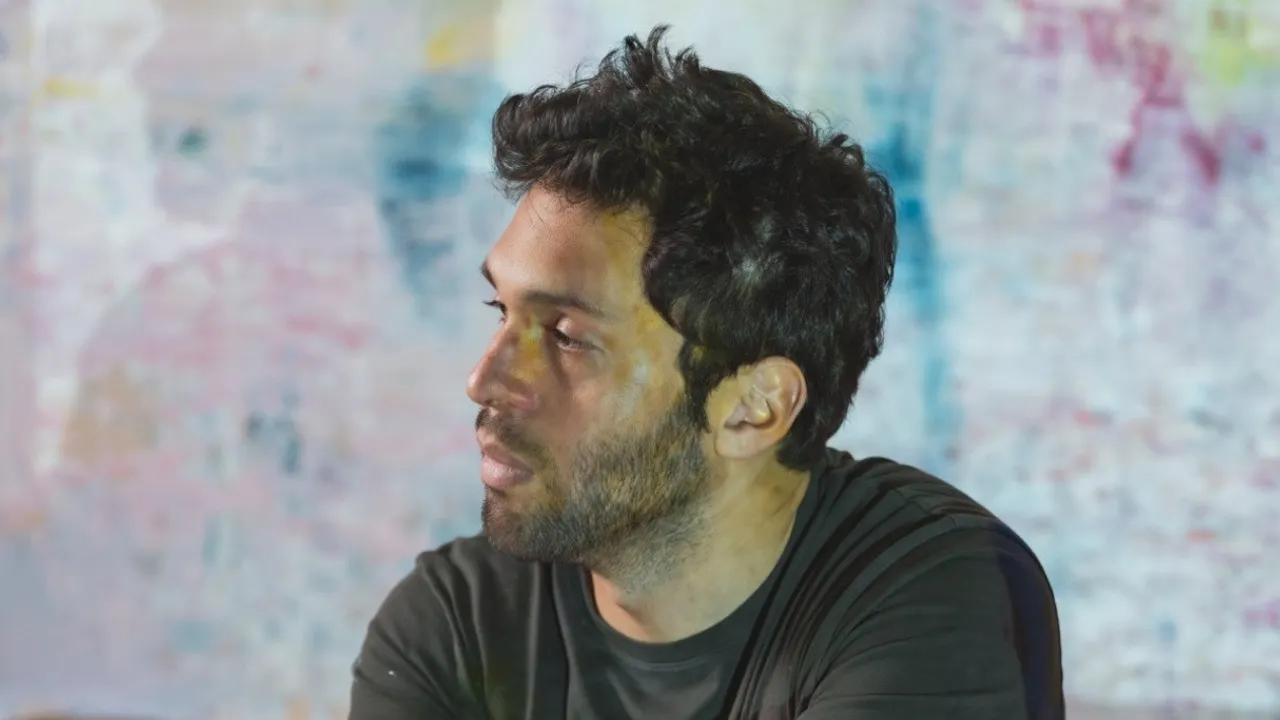
© Portrait d’Alexandre Lenoir, © photo Charles Roussel
Alexandre Lenoir. Par la force des choses
- From środa, marca 25 to poniedziałek, sierpnia 24
- 10:00-20:00
- Le Musée de l'Orangerie Jardin des Tuileries, 75001 Paris, Francja
Info
Alexandre Lenoir, born in 1992, primarily paints landscapes traversed by often ghostly figures, indifferent to the viewer. His paintings are executed from photographs that he chooses as memories of happy moments, although they are dominated by an imperious nature to which he concedes an element of arbitrariness. Rather than faithfully representing nature, he seeks an alchemy that gives rise to works that appear to have been created spontaneously, almost without the artist’s intervention. From these familiar scenes bathed in brilliant light emanates a surprising melancholy. On the occasion of the 16th Contemporary Counterpoint at the Musée de l’Orangerie, Alexandre Lenoir presents four previously unseen canvases.
Lenoir works from instructions he gives to himself or to non-painter assistants, on images transformed by time — both the interval between the moment of the photograph and the painting, and the time required for its slow realization. He proceeds by applying countless layers of paint, from the lightest to the darkest, laid over a multitude of small pieces of tape that mask and then free the canvas, translating the projected image from which he paints without any "romantic" effects.
Alexandre Lenoir: “It began with a canvas titled Les Cévennes, where to represent the surface of the water and its reflections I had to find a way to make as few brushstrokes as possible. That’s when the tape came into play, as a means of preparing the ground for my paint washes, which I brushed laterally across the canvas like a printer. At the end, when I removed the tape, I saw an image as if I had dreamed it, whose architecture and frames were present at the origin but within which the paint had taken over. Afterwards, I developed a very intimate relationship with this translative method that leads me to mask, cover and then reveal. In short, it is a form of revelation that can evoke photographic development. It allows me to leave a space of freedom for the viewer who looks at the canvas in the end, because I do not want to be the only one to impose the image on them.”
In this respect the painter’s ambition echoes Monet’s: to work on perception, on the invisible. “I have undertaken again things impossible to do,” Monet wrote to Gustave Geffroy on 22 June 1890, “water with grass undulating in the depths […] it is admirable to see, but it drives one mad to try to do it. Still, I always attack these things!” (Letter cited in Gustave Geffroy, Monet, sa vie, son œuvre [1924], Paris, Macula, 1980, p. 30).
Alexandre Lenoir experiments with the tension between an asserted realism and creative processes that are as elaborate as they are experimental. He works on the “act of seeing” in relation to the gesture that will create the image: the movement of water, the gesture of the tree organizing a kind of ecosystem comparable to that desired by Claude Monet when inventing the large-scale decorations: “I was tempted to employ the theme of the Water Lilies in decorating a salon: carried along the walls, enveloping all the surfaces in its unity, it would have procured the illusion of an endless whole, a wave without horizon and without shore.” (Claude Monet cited by Roger Marx, “Les Nymphéas de M. Claude Monet,” Gazette des beaux-arts, June 1909).
“When I rediscovered the Water Lilies,” Lenoir explains, “I was struck by the way the water moved to the rhythm of the changing light in the exhibition rooms. Indeed, the material of the canvases was such that the light would sometimes cling and then immediately slip away, creating in my eye the constant movement of water. I am very interested in painting as a living entity. Through repetitive gestures and their vagaries, the life of the studio always yields an image that surprises me but fully embodies the water of the canvases I will present for the exhibition.”
He questions what it means to be a painter, and it is certainly this questioning that can be perceived in his complex paintings despite their apparent exterior. He willingly recalls the maxim of the artist Niele Toroni, “Work so that the painting works by itself,” which he adopts as a rule to be observed and transgressed.
Cover: Portrait of Alexandre Lenoir, © ADAGP, Paris, 2026 © photo Charles Roussel
Closed on Tuesdays
Participants
Miejsce
Le Musée de l'Orangerie
Jardin des Tuileries, 75001 Paris, Francja