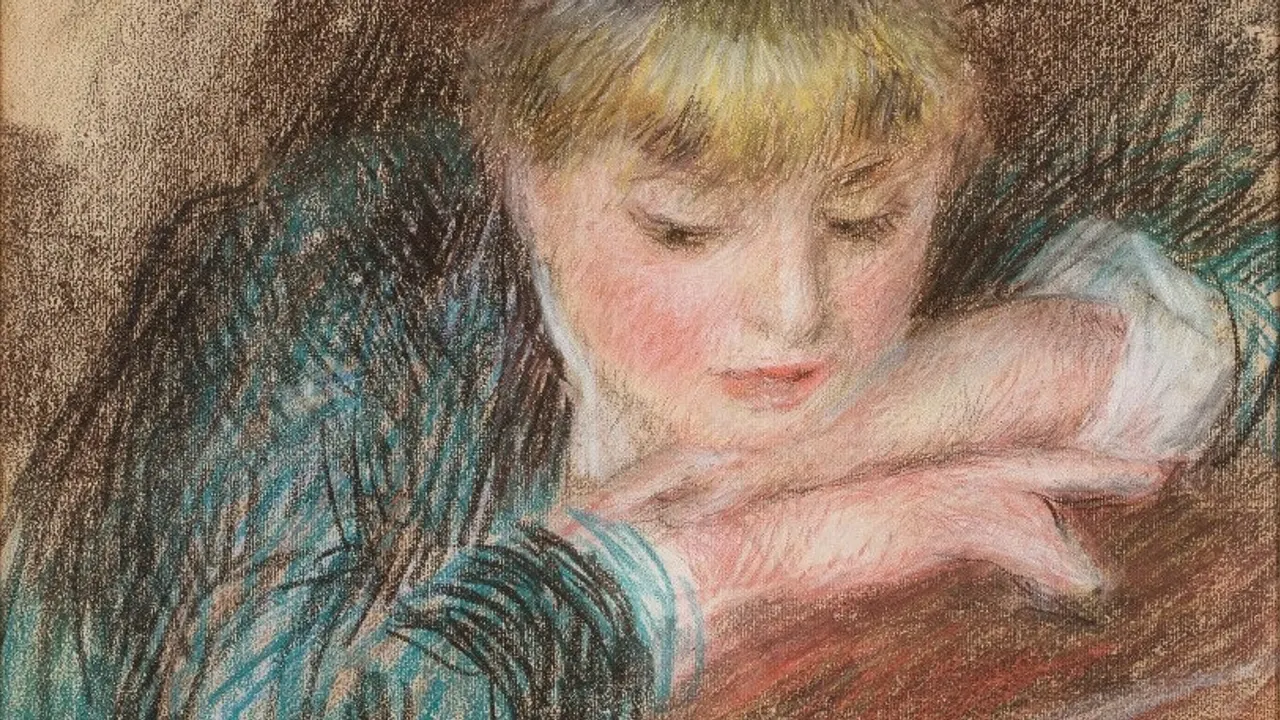
© Jeune femme penchée sur un balcon, dit aussi La Loge, 1879, © © 2023 Fondation Bemberg / Mathieu Lombard
Renoir dessinateur
Opublikowane przez Musée d'Orsay
- From wtorek, marca 17 to niedziela, lipca 5
- 10:30-20:00
- Musée d'Orsay Esplanade Valéry Giscard d'Estaing, 75007 Paris, Francja
Info
Co-organized with the Morgan Library & Museum, this exhibition—the first devoted to Renoir’s works on paper—will highlight the importance of graphic techniques in the development of his art. It also reveals the intimate connections between his paintings and his drawings, particularly from the 1880s onward, when Renoir moved away from Impressionism but continued to reinvent himself.
Although Renoir’s paintings remain among the icons of Impressionism, his works on paper (drawings, watercolors, pastels…) have not, until now, received the same attention. It is true that the artist, above all recognized as a great painter and colorist, long suffered from a reputation as a poor draftsman. It is also true that the corpus of his graphic works is limited (Renoir likely destroyed many of his drawings) and heterogeneous, comprising quick sketches, studies for painted compositions, large tracings, on-site “notations” in watercolor, fully realized signed pastels that were exhibited and sold to collectors, print or illustration projects, and more. Yet drawing played a decisive role in the development of Renoir’s art, from his earliest student exercises in the 1850s–1860s to his most modern late investigations in the 1910s.
Thus, for certain works—such as The Bathers. Essay in Decorative Painting, or Maternity—he produced multiple studies to arrive at the perfect form, a fact commented on by Berthe Morisot:
"[Renoir] is a draftsman of the highest order; all these preparatory studies for a painting would be interesting to show to the public, who generally imagine that the Impressionists work with the utmost casualness." (Berthe Morisot)
The exhibition, which will present around one hundred works from around the world—including sheets never before seen and several paintings—is conceived as an immersion into the intimacy of the artist’s creative process, bringing the visitor close to his investigations of light, form, and color.
It will also offer the chance to admire the unsuspected ease and great freedom with which the artist approached a wide variety of techniques: graphite, Conté crayon, charcoal, pen and ink (black or red), pastels, watercolors, gouaches, and so on. Special attention will be given to the sanguine technique (red chalk), which, for a number of reasons—flexibility and thickness of line, the red hue’s association with depictions of flesh and the nude, references to the 18th-century masters whom Renoir admired, etc.—became the artist’s preferred medium from the 1880s onward.
At the beginning of the 20th century these works drew the admiration of many artists, among them Bonnard ("Bonnard speaks with unaffected modesty [...] of Renoir’s drawing, which he believes himself unable to match," wrote Thadée Natanson) and Picasso, who owned one of Renoir’s most spectacular sanguines, shown as the conclusion of the exhibition. Gauguin, for his part, coined this phrase: "A painter who never learned to draw but who draws well—that is Renoir," likely distinguishing between drawing as an academic technique, which Renoir seldom practiced, and drawing as a sense of form and structure, in which Renoir proved a master.
Cover: Young Woman Leaning on a Balcony, also known as The Loge, 1879, © 2023 Fondation Bemberg / Mathieu Lombard
Organizator
-
 Musée d'Orsay
@museeorsay
Miejsce
Musée d'Orsay
Esplanade Valéry Giscard d'Estaing, 75007 Paris, Francja