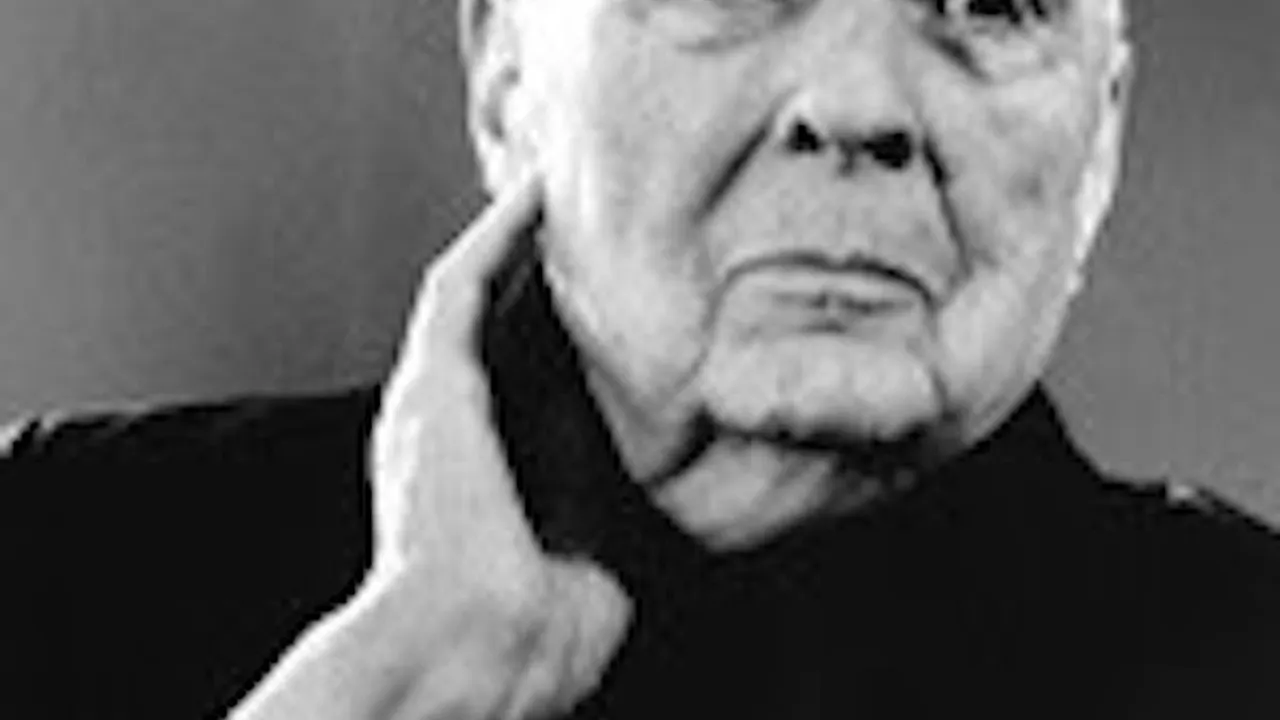
Exposition Gottfried Honegger
Opublikowane przez Centre Pompidou
- From środa, czerwca 24, 2015 to poniedziałek, września 14, 2015
- 11:00-21:00
- Le Centre Georges Pompidou - Beaubourg place Georges Pompidou, 75004, Paris
Gottfried Honegger remains an artist ripe for rediscovery. By focusing on the origins and development of his Tableaux-reliefs, the Centre Pompidou’s tribute brings his artistic career back into the spotlight. Few people know that the artist and his wife, Sybil Albers, rank among the major donors of modern and contemporary art to French public collections. Their collection—more than 550 works donated to the French state, encompassing avant-garde and abstract artists—has been housed since 1990 at the Espace de l’Art Concret in Mouans-Sartoux, in the Alpes-Maritimes.
A leading figure in Concrete art, Gottfried Honegger, now aged 97, began his career as a graphic designer in Zurich. During a stay in Paris in 1939, he produced his first landscapes and a handful of Cubist-style portraits. The Second World War interrupted this early momentum, and after returning to Switzerland, Honegger did not resume his artistic practice until 1949. Close to Zurich’s Concrete artists, he began painting compositions in the early 1950s that combined references to nature with geometry. In 1958, during a stay in New York, he met artists associated with Abstract Expressionism. He also decided to devote himself exclusively to his art. In 1960, at New York’s Martha Jackson Gallery, Honegger exhibited works that foreshadowed the Tableaux-reliefs: red monochromes whose surfaces were enlivened by repeating, shallow geometric elements covered in acrylic paint. That same year, Gottfried Honegger settled in Paris and established ties with Aurélie Nemours, Sonia Delaunay and Michel Seuphor, an important historian and critic of abstract art. Fascinated by the biologist Jacques Monod’s book Chance and Necessity, Honegger became one of the first artists in France to use computing in his work, producing a series of computer-programmed drawings as early as 1970. The idea of programming also informed the design of the Tableaux-reliefs, which grew to monumental proportions. The distribution of colours and shapes, module by module, was likewise left to chance through throws of the dice.
Despite its serial nature, this body of work avoids monotony and allows the artist to explore a wide range of approaches. The 1980s saw the emergence of diptychs, triptychs and paintings with stretchers cut into two sections, subtly offset so that the exhibition wall became a structuring element. Since the 1990s, the Tableaux-reliefs—freed from the picture plane—have engaged with space as reliefs or painted metal sculptures. The Pliages, white cylinders opened up by cuts that unfold into the surrounding space, form the culmination of this exhibition devoted to an artist whose career combines sensitivity with a radical approach.
Organizator
-
Centre Pompidou
@centrepompidou
Participants
Miejsce
Le Centre Georges Pompidou - Beaubourg
place Georges Pompidou, 75004, Paris